Space-Grown Crystals Could Unlock New Cancer Drugs
Varda Space Industries is manufacturing potential cancer drugs in microgravity, aiming to revolutionize pharmaceutical production.
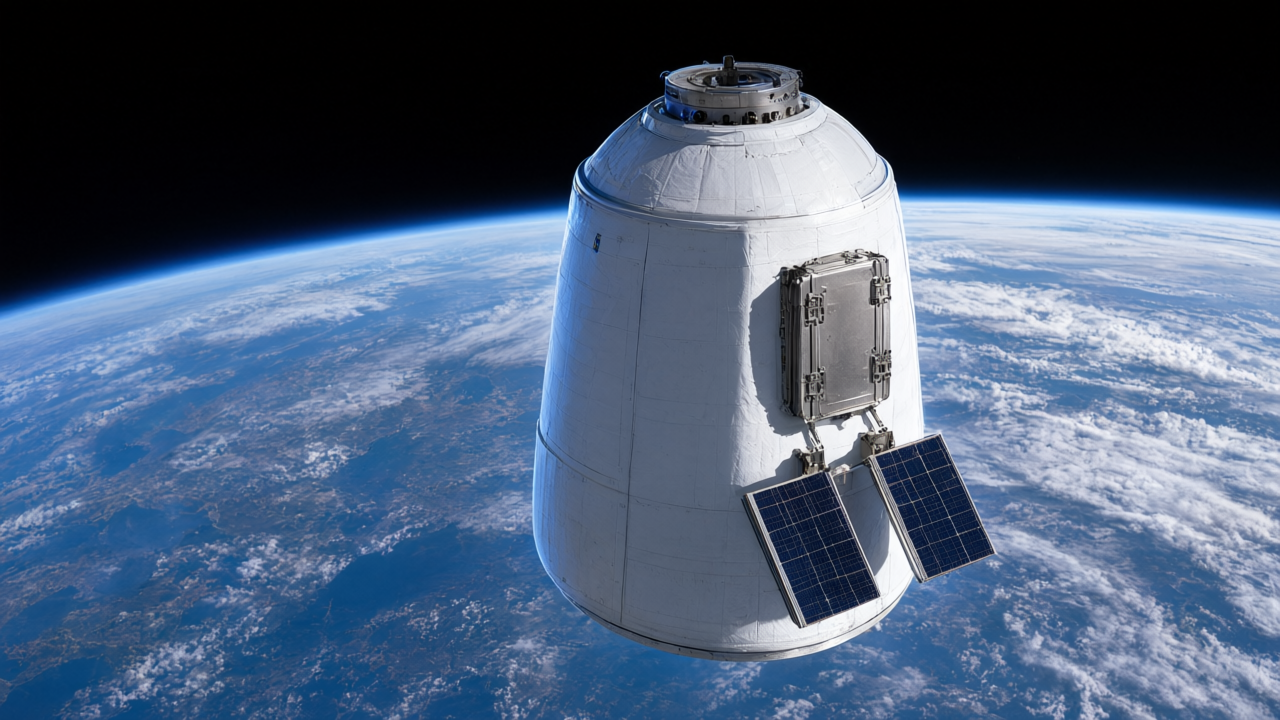
Roughly 300 miles above Earth’s surface, a silent industrial revolution is underway. Inside orbiting capsules, tiny crystals of potential cancer drugs are being grown in the weightlessness of space. This effort by California-based Varda Space Industries represents a significant leap toward commercializing space manufacturing, moving beyond scientific experiments to produce materials that could transform medicine and technology on Earth.
The spacecraft belong to Varda Space Industries, which recently achieved a historic milestone by launching three re-entry vehicles simultaneously. Two launched on October 1 aboard the same rocket, with a third following on October 20. These capsules serve different purposes: one grows drug crystals, while the others test heat protection materials and navigation systems for hypersonic re-entry into the atmosphere.
Will Bruey, Varda’s chief executive, emphasized the significance of this achievement. He noted that his company is the first in human history to launch multiple commercial re-entry vehicles at once. As launch frequency increases, the concept of manufacturing products in space is shifting from a futuristic idea to a tangible reality.
The primary advantage of space manufacturing lies in microgravity. On Earth, gravity causes particles in liquids to settle and creates density-driven currents, both of which can disrupt the orderly growth of crystals. Removing these forces allows crystals to form in a more structured way. For pharmaceuticals, the size, shape, and arrangement of drug crystals determine how easily they dissolve, their stability, and their method of administration.
This precision could enable new drug formulations. Currently, some medicines require intravenous infusions due to their physical properties. Space-grown crystals might allow these drugs to be reformulated into more convenient injections, improving patient comfort and treatment efficiency. The benefits extend beyond medicine; semiconductors used in smartphones and electric vehicles could also be produced with fewer defects in the vacuum of space.
Dr. Meganne Christian, mission manager at the UK-based Satellite Applications Catapult, highlighted the potential for creating purer materials. She expressed interest in producing graphene in microgravity, noting that terrestrial production often results in crystal defects that reduce performance. Reducing these defects could lead to higher-performing materials for various industries.
While scientists have experimented with microgravity manufacturing for decades, primarily aboard the International Space Station (ISS), the ISS is not optimized for industrial-scale production. Scheduled for retirement around 2030, it has served mainly as a testbed. Commercial entities are now developing autonomous factories to fill this gap, removing humans from the process to avoid vibrations and contamination.
Varda’s approach involves free-flyers that hitch rides on SpaceX rockets. These capsules carry miniature laboratories where materials are processed without astronauts. Once experiments are complete, the capsule separates, plunges through the atmosphere, and parachutes to an uninhabited region on Earth. This autonomous cycle allows for frequent experimentation, crucial for the rapid pace of modern drug development.
Other companies are exploring similar avenues. Cardiff-based Space Forge is testing hybrid methods for semiconductor production, using space-grown crystals as templates for larger quantities on Earth. Andrew Bacon, co-founder and chief technology officer, believes recent developments signal the start of a new industrial revolution, though challenges regarding cost and viability remain.
“Varda Space Industries is manufacturing potential cancer drugs in microgravity, aiming to revolutionize pharmaceutical production.”
Sources
Reporting informed by The Guardian. This story was written by the Glob News Desk based on verified reporting and independently reviewed before publishing.
Written by
Glob News Desk
AI-assisted editorial team
Stories researched and drafted with AI assistance from verified news sources, then reviewed by a human editor before publishing.
Spotted an error, or have something to say about this story?
Tell the newsroom
Read next
Lab-Grown Meat: The Promise vs. Reality
A decade after the first lab-grown burger, cellular agriculture struggles with high costs and regulatory hurdles despite early climate promises.
2 min read
The Weekly Globe
One email a week with the most-read stories. Unsubscribe anytime.
Related stories
ScienceLab-Grown Meat: The Promise vs. Reality
 Science
Stonehenge Altar Stone Origin Mystery Deepens as New Theory Ruled Out
 Science
Comments
0Join the conversation — sign in to post a comment.