Scientists Decode Ancient Roman 'Magic' Color-Changing Glass
Researchers replicate the optical engineering of the 1,600-year-old Lycurgus Cup, revealing how Romans manipulated light with gold and silver nanoparticles.
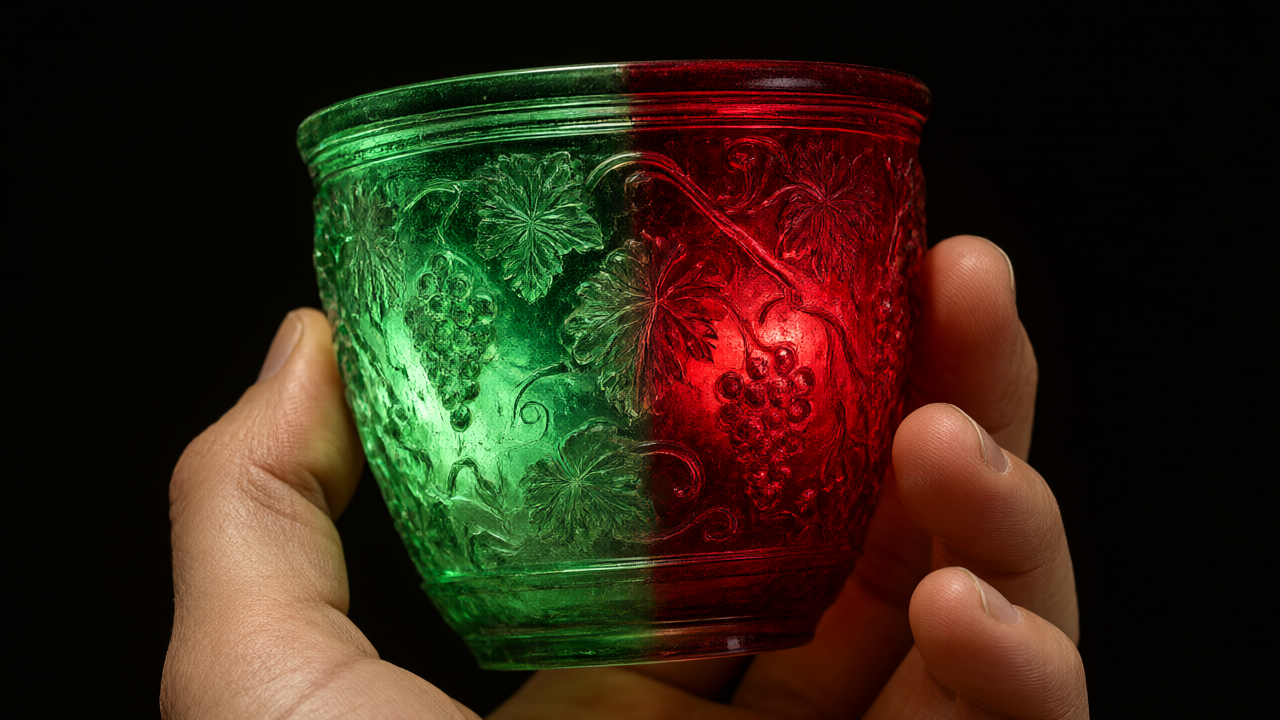
Scientists from the University of Sheffield have successfully decoded the optical engineering behind the Lycurgus Cup, a 1,600-year-old Roman masterpiece that baffled experts for centuries. The fourth-century artifact, housed in the British Museum, is renowned for its ability to change color depending on the light source: it appears jade green under normal lighting but turns ruby red when illuminated from behind. This feat of ancient technology has now been replicated using an original recipe derived from a fragment of the dichroic glass.
The project was led by Dr. Lisa Hollands, a technician at the university’s school of chemical, materials and biological engineering, who worked alongside Professor Caroline Jackson, a leading expert in Roman glass. For Hollands, replicating the cup’s behavior was a "labour of love," noting that while others had attempted similar experiments with limited success, her team achieved a precise match to the original's optical properties. She described the result as "magic," highlighting the sophistication of Roman craftsmanship.
The original Lycurgus Cup features a mythological frieze carved in deep relief, depicting the legend of King Lycurgus from Homer’s Odyssey. The scene shows Dionysus, the god of wine, triumphing over Lycurgus, who is ensnared by a vine. In 2022, an international panel recognized the cup as one of the seven glass wonders of the world, underscoring its significance in the history of material science and art.
The key to the cup’s color-changing effect lies in the embedding of gold and silver nanoparticles into the glass matrix. Each particle is approximately a thousand times smaller than a grain of sand. As the thick molten glass cooled from temperatures exceeding 1,000 degrees Celsius, these nanocrystals grew around particles within the mixture. This process allowed the glass to interact with light in unique ways, blocking certain wavelengths while allowing others to pass through.
Dr. Hollands explained the physics behind the phenomenon: white light consists of many colors, and the nanoparticles block specific colors by affecting electrons in the atoms. When light shines through the glass, the gold and silver particles block blue and green light, allowing only reds and oranges to pass. Conversely, when light reflects off the surface, the particles scatter the light, creating the opaque green appearance seen in ambient conditions.
To bring this ancient technique to life, the University of Sheffield commissioned glass artist Elliot Walker to create a contemporary sculpture. The piece pays homage to the "ancient twin" by combining the story of Lycurgus with elements of the Farnese Atlas sculpture, replacing the globe with a cup. Walker stated that the project offered him a profound connection with the Roman makers, bridging the gap between ancient craft and modern artistic expression.
The new replica will be unveiled at the Millennium Gallery as part of the university’s Festival of the Mind from November 6 to 15, before moving to a permanent display at the Turner Museum of Glass. Ian Freestone, emeritus professor of archaeological materials at University College London, praised the project for its precision. He noted that while a similar colored glass was replicated in the 1960s, Sheffield’s version is much closer to the actual shades of the Lycurgus Cup.
Freestone highlighted the difficulty the Romans faced in controlling the furnace conditions to achieve such sensitive color variations. He suggested that the craftsmen may have 'hit the jackpot' due to their ability to control furnace conditions precisely. He also noted a theory that the red-green colors symbolized the ripening of grapes, fitting for a drinking vessel used in ceremonies related to the depicted myth.
Historical records further support the ceremonial use of such items. A letter attributed to Emperor Hadrian mentions sending "parti-coloured cups that change colour" to his brother-in-law, recommending their use at banquets on feast days. This replication not only preserves a technological mystery but also offers insight into the daily rituals and aesthetic values of the Roman Empire.
“Researchers replicate the optical engineering of the 1,600-year-old Lycurgus Cup, revealing how Romans manipulated light with gold and silver nanoparticles.”
Sources
Reporting informed by Guardian Science. This story was written by the Glob News Desk based on verified reporting and independently reviewed before publishing.
Written by
Glob News Desk
AI-assisted editorial team
Stories researched and drafted with AI assistance from verified news sources, then reviewed by a human editor before publishing.
Spotted an error, or have something to say about this story?
Tell the newsroom
Read next
Seabirds Suffer Jet Lag When Migrating
Oxford study reveals Manx shearwaters get lost during migration because their internal clocks fall out of sync with local time zones.
2 min read
The Weekly Globe
One email a week with the most-read stories. Unsubscribe anytime.
Related stories
ScienceSeabirds Suffer Jet Lag When Migrating
 Science
AI Unlocks Secrets of Britain's Rarest Bats in Massive Survey
 Science
Comments
0Join the conversation — sign in to post a comment.