Rare 'Nanotyrannus' Skeleton Sells for $47.3 Million at Auction
A rare dinosaur skeleton nicknamed Jodi has sold for nearly $50 million, reigniting debate over private ownership of fossils.
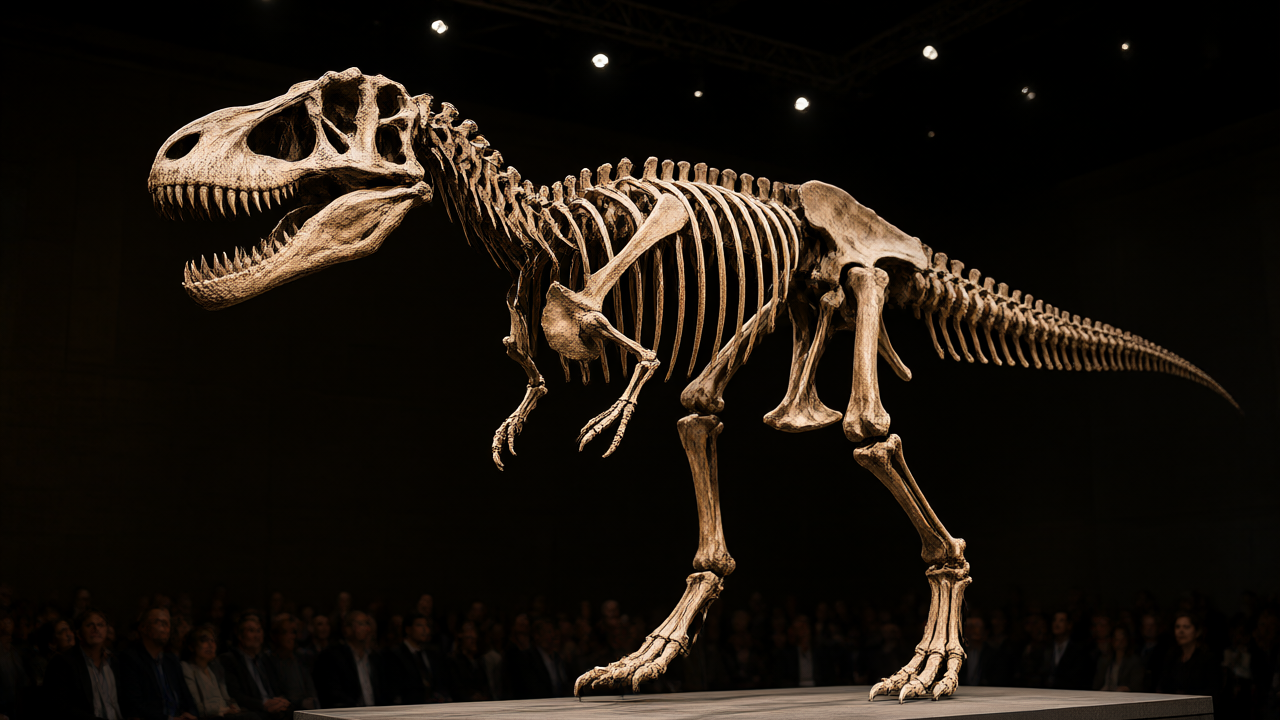
A rare dinosaur skeleton known as 'Jodi' has sold at auction for $47.3 million (£35.5 million), marking one of the highest prices ever paid for a fossil and sparking renewed controversy over whether such scientific treasures should remain in public museums or enter private collections.
The mounted skeleton of the Late Cretaceous carnivore was sold by Sotheby's in New York on Tuesday. The sale price far exceeded initial estimates that placed the value at least at $9 million. It becomes the second-most valuable dinosaur fossil ever sold, trailing only 'Gus,' a Tyrannosaurus rex skeleton that fetched $50.1 million last July.
Jodi is a roughly 10-foot-tall (3-meter) specimen comprising about 191 fossil-bone elements. Sotheby's described it as an exhibition-ready skeleton with a beautifully preserved, virtually complete skull. It is one of only three Nanotyrannus skeletons known to science and the first to come to market since researchers confirmed the genus as distinct from T. rex last October.
For decades, scientists debated whether Nanotyrannus was merely a juvenile T. rex or a separate species. The consensus shifted after the discovery of the 'Dueling Dinosaurs' fossil, which showed a Nanotyrannus and Triceratops in apparent combat. This discovery supported research classifying Nanotyrannus as its own genus, ending years of academic dispute.
Megan Jacobs, a palaeontologist at the University of Portsmouth, explained that while Nanotyrannus was long thought to be a teenager of T. rex, it is actually smaller, more slender, and equipped with blade-like teeth designed for slicing meat. Both dinosaurs lived alongside each other approximately 67 million years ago during the same geological period.
The skeleton was discovered in Montana’s Hell Creek Formation by rancher Jodi Pierson. It was later excavated by commercial palaeontologist Clayton Phipps, who also found the Dueling Dinosaurs specimen eight miles away in 2006. Before its reclassification, Jodi was exhibited as a juvenile T. rex at London’s Frieze Masters art fair in October 2023.
The high-profile sale has drawn sharp criticism from some experts in the scientific community. Professor Steve Brusatte of the University of Edinburgh called the prospect of Jodi disappearing into private vaults 'harrowing.' He argued that such remains belong in public spaces where they can be studied freely and used to inspire the public, comparing the situation to a super-wealthy individual owning the Mona Lisa without displaying it.
However, Jacobs noted that excavation requires significant time, effort, and money. She stated she does not begrudge those involved for seeking a large return on their investment. While acknowledging the scary prospect of private ownership, she expressed hope that these specimens will eventually end up in museums where they can be viewed by the public.
The identity of the buyer, who won after 12 minutes of bidding among six interested parties, has not been disclosed. The transaction highlights a growing trend of ultra-wealthy collectors acquiring significant scientific artifacts, raising questions about accessibility, research integrity, and the future of paleontological education.
“A rare dinosaur skeleton nicknamed Jodi has sold for nearly $50 million, reigniting debate over private ownership of fossils.”
Sources
Reporting informed by BBC Science. This story was written by the Glob News Desk based on verified reporting and independently reviewed before publishing.
Written by
Glob News Desk
AI-assisted editorial team
Stories researched and drafted with AI assistance from verified news sources, then reviewed by a human editor before publishing.
Spotted an error, or have something to say about this story?
Tell the newsroom
Read next
Seabirds Suffer Jet Lag When Migrating
Oxford study reveals Manx shearwaters get lost during migration because their internal clocks fall out of sync with local time zones.
2 min read
The Weekly Globe
One email a week with the most-read stories. Unsubscribe anytime.
Related stories
ScienceSeabirds Suffer Jet Lag When Migrating
 Science
AI Unlocks Secrets of Britain's Rarest Bats in Massive Survey
 Science
Comments
0Join the conversation — sign in to post a comment.