Dictionary.com Names 'Maxxing' Word of the Year for 2026
The suffix '-maxxing', used to describe optimizing every aspect of life, has been chosen as the word of the year.
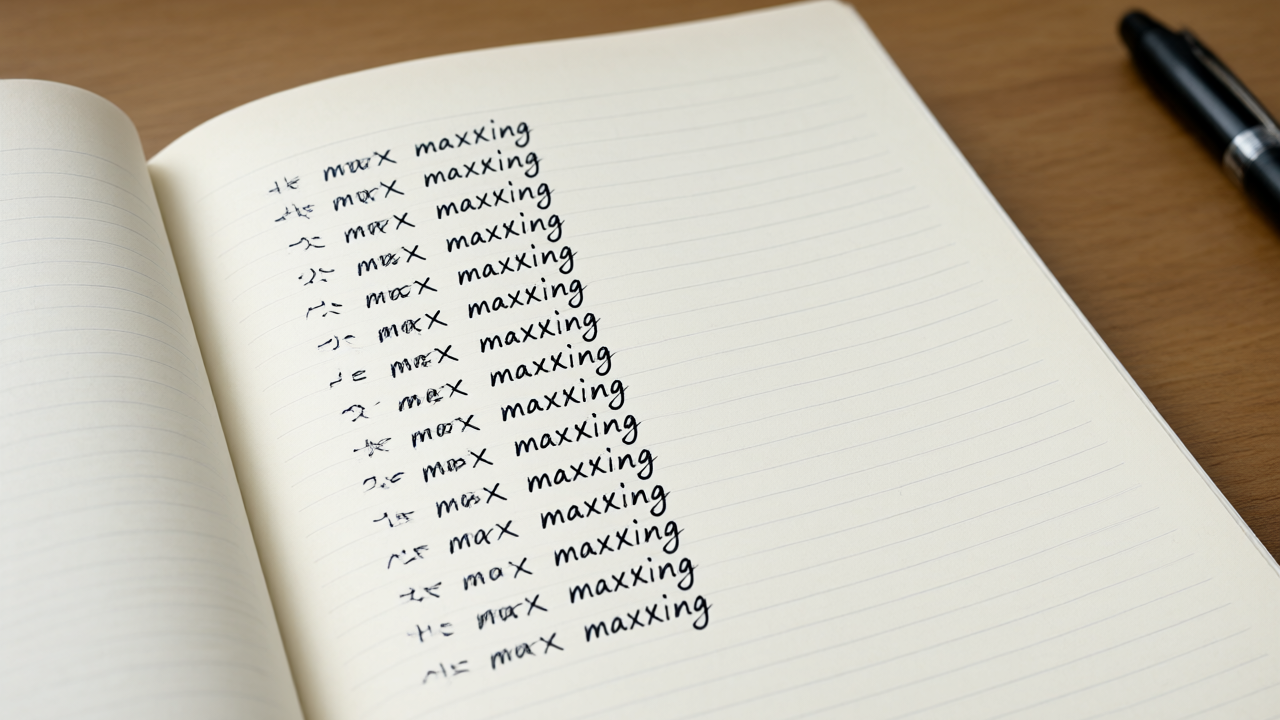
The linguistic landscape of 2026 has been defined by a relentless drive for self-improvement and digital optimization, culminating in Dictionary.com’s announcement that 'maxxing' is its Word of the Year. The suffix, attached to nearly any noun or verb, signals an attempt to extract the absolute maximum potential from a specific activity or trait. From 'sleepmaxxing' to 'lethalitymaxxing,' the term has become inescapable in modern discourse, reflecting a cultural shift where efficiency and enhancement are prioritized above all else.
While the concept of maximizing attributes is not new, its recent explosion in usage marks a distinct departure from earlier iterations. Dungeons and Dragons players have long utilized 'min-maxing' to balance character statistics, and the phrase 'maxin’ and relaxin’' was popularized by Will Smith in the 1990s. Game theorists also employed similar terminology as far back as the 1940s. However, the contemporary application of 'maxxing' transcends these niche origins, permeating daily life with a pervasive urgency to improve every facet of existence.
Steve Johnson, director of lexicography for the Dictionary Media Group, explained that the selection process involves analyzing search trends, social media activity, and news cycles to identify the term that tells the most compelling story of the year. In this instance, 'maxxing' stood out due to its versatility. It connects disparate parts of human experience, allowing users to describe everything from 'proteinmaxxing' their breakfast to 'tokenmaxxing' their use of artificial intelligence during the workday.
The surge in popularity is largely attributed to the phenomenon of 'looksmaxxing,' which involves prioritizing physical appearance and pursuing extreme measures to enhance it. Linguist Adam Aleksic notes that the message board 4chan is responsible for a vast amount of current slang, and 'looksmaxxing' has roots in online communities that often focus on self-optimization. This origin point fueled the recent rise in the word's usage, embedding it deeply within internet culture before it spread to broader audiences.
Despite its controversial beginnings, the suffix has emerged from the shadows of niche online forums. Kelly Wright, associate editor of *Among the New Words*, documents the term’s evolution from 1990 D&D contexts through 2010s posts on imageboards to 2025 discussions on platforms like YouTube and Substack. Examples include 'vibemaxxing,' described as adding to one’s energy, and 'vocabularymaxxing,' which refers to acquiring words necessary to express complex thoughts. This trajectory highlights the term’s adaptability across different digital spaces.
Data from Dictionary.com supports the observation of rapid adoption. By August 2026, the term was being used in digital media 19 times more frequently than its monthly average in 2025. Jennifer Donnelly, a researcher at RCSI University of Medicine and Health Sciences, observes that the word captures a social media-driven compulsion to optimize. She notes that if there is an aspect of life that could be improved, it can likely be 'maxxed,' suggesting a belief that improvement processes have definitive endpoints.
However, experts warn of the psychological risks associated with this mindset. The pursuit of an idealized 'optimal' self can fuel constant self-surveillance and criticism. Health, wellbeing, and social relationships are not tasks to be completed but ongoing processes. The obsession with maximization may lead individuals to view their natural states as inadequate, creating pressure to constantly refine their habits and identities without ever feeling satisfied.
This trend toward optimization is evident in other lexical additions as well. Johnson points to the rise of prefixes meaning 'much more,' such as 'hyper,' 'ultra,' and 'super.' These terms complement 'maxxing' by emphasizing intensity and excess. Together, they reflect a societal preference for amplified experiences and heightened states of being, reinforcing the idea that more is inherently better.
Linguists agree that the term’s structure contributes significantly to its appeal. Daria Bahtina, a lecturer in linguistics at UCLA, describes 'maxxing' as infinitely customizable yet instantly recognizable. Attaching the pattern to almost anything allows speakers to participate in a specific cultural moment while sounding modern and engaged. Saying one is 'proteinmaxxing' carries more stylistic weight than simply stating an intention to eat more protein, making the term socially advantageous.
“The suffix '-maxxing', used to describe optimizing every aspect of life, has been chosen as the word of the year.”
Sources
Reporting informed by Guardian Science. This story was written by the Glob News Desk based on verified reporting and independently reviewed before publishing.
Written by
Glob News Desk
AI-assisted editorial team
Stories researched and drafted with AI assistance from verified news sources, then reviewed by a human editor before publishing.
Spotted an error, or have something to say about this story?
Tell the newsroom
Read next
The Unlikely Halloween Star: M&S Director Inspires Viral 'Gay Halloween' Trend
A Marks & Spencer food director has become an unexpected internet icon, inspiring a niche but popular Halloween costume trend among fans.
3 min read
The Weekly Globe
One email a week with the most-read stories. Unsubscribe anytime.
Related stories
CultureThe Unlikely Halloween Star: M&S Director Inspires Viral 'Gay Halloween' Trend
 Culture
Sarah J Maas new novel release sparks ticket chaos and fan mania
 Culture
Comments
0Join the conversation — sign in to post a comment.